
The Essential Pages Every Business Website Needs (and Why They Matter)
15 – 17 MIN READ
Building a website isn’t about adding as many pages as possible—it’s about creating the right pages, each with a clear purpose. Together, those pages create an experience that guides visitors, builds trust, and helps them confidently take the next step.
When you’re planning a new website, it’s easy to think about each page individually. You start with a homepage, then add an About page, Services page, Contact page, and maybe a blog if you plan to publish content regularly.
The truth is, great websites aren’t just collections of pages—they’re thoughtfully connected experiences. Every page answers a different question, supports the next step in the visitor’s journey, and works together to help your business grow.
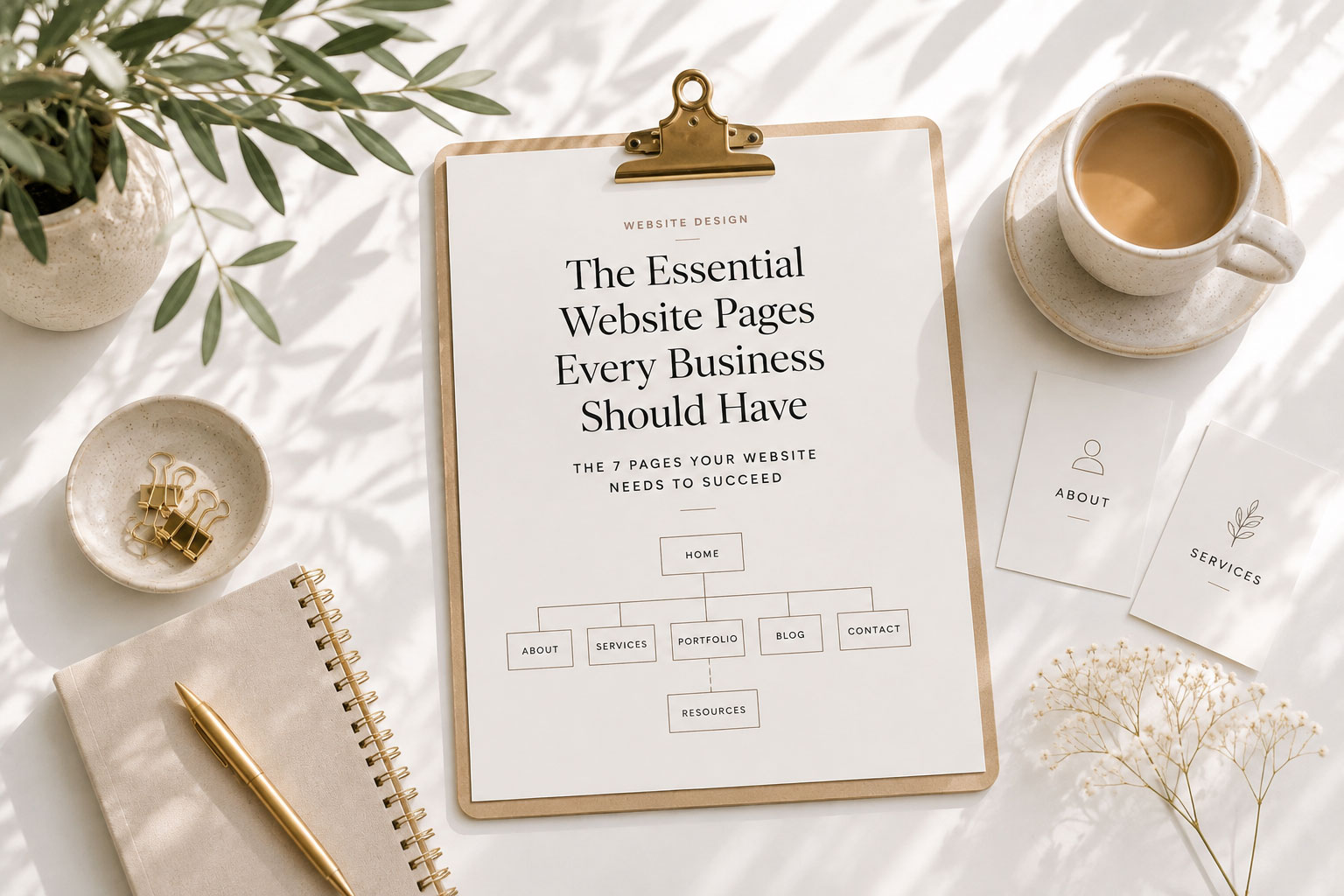
Whether someone is discovering your business for the first time or they’re almost ready to work with you, your website should help them feel informed, confident, and comfortable moving forward.
In this article, we’ll explore the essential pages every business website should have, why each one matters, and how they work together to create a website that’s both beautiful and effective.
In This Article
01 Why Every Page Matters
02 Homepage
03 About
04 Services
05 Blog
06 Contact
07 Resources
08 FAQ
09 Testimonials & Case Studies
10 Legal Pages
11 Optional Pages That Help Your Website Grow
12 Bringing It All Together
01. Why Every Page Matters
When you’re building a website, it’s easy to focus on the design—the colors, fonts, photography, and layout. While those details certainly matter, the most effective websites have something even more important in common: every page has a clear purpose.
Think of your website as a conversation with a potential customer. Each page answers a different question, guiding visitors naturally from their first impression to the moment they’re ready to take the next step.
Your homepage introduces your business and helps visitors understand they’re in the right place. Your About page builds trust by sharing your story and expertise. Your Services page explains how you can help, while your Contact page makes it easy for someone to reach out when they’re ready.
When every page has a defined role, your website becomes easier to navigate, easier to understand, and far more effective at turning visitors into customers.
When pages overlap, repeat the same information, or leave important questions unanswered, visitors can quickly become confused or lose confidence. Instead of taking the next step, they may leave without ever discovering what you offer or how you can help.
The goal isn’t to create the biggest website possible—it’s to create a thoughtful collection of pages that work together. Each page should build on the one before it, creating a seamless experience that feels intentional from beginning to end.
A great website isn’t built from one beautiful page—it’s built from a collection of pages that work together to guide visitors from curiosity to confidence.

Designer Insight:
Before adding a new page to your website, ask yourself one simple question:
“What purpose does this page serve?”
If you can’t answer that clearly, the page may be unnecessary—or its content might belong somewhere else. The strongest websites aren’t the ones with the most pages; they’re the ones where every page earns its place.
02. Homepage
Your First Impression Matters
Your homepage is your website’s introduction. Within seconds, visitors decide whether your business feels trustworthy, relevant, and worth exploring further.
It doesn’t need to say everything—it simply needs to create clarity, build confidence, and guide visitors toward the next step.
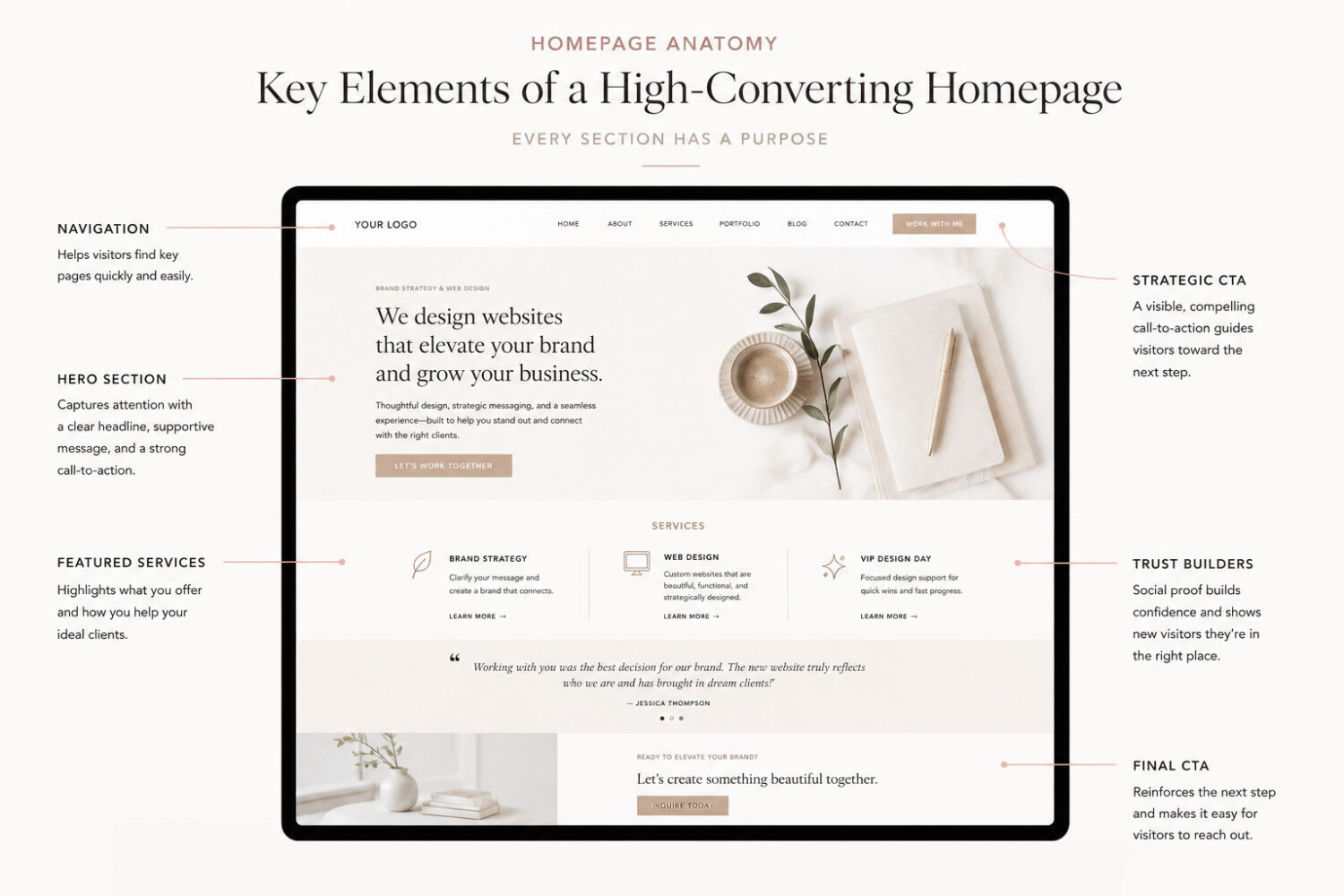
A strong homepage should quickly answer a few important questions:
When those answers are immediately clear, visitors are far more likely to stay on your website and continue learning about your business.
Every Great Homepage Includes
Common Mistake
Many homepages try to answer every question at once. Long paragraphs, competing buttons, and too many choices overwhelm visitors before they’ve even understood what your business offers.
Instead, simplify. Every section should move visitors one step closer to becoming a customer.
Continue Reading
Ready to build a homepage that guides visitors from curiosity to confidence?
Read next: Homepage Design: 10 Elements Every Great Website Needs
Designer Insight:
People care more about where you’re taking them than how you’ll get there.
03. About Page
Where Trust Begins
If your homepage answers “What do you do?”, your About page answers an equally important question:
“Why should I trust you?”
People don’t just hire businesses—they hire the people behind them. Before someone invests in your services, they want to know who you are, what you value, and whether you’re the right fit.
Your About page is where that connection begins. It’s an opportunity to introduce yourself, share your story, and show the people behind the brand. When done well, it helps your business feel approachable, credible, and memorable.
That doesn’t mean writing a long autobiography. Instead, focus on the details that help visitors understand your experience, your values, and how you can help them move forward with confidence.
Every About Page Should Include:
Common Mistake
One of the biggest About page mistakes is making the page entirely about you. Your story matters—but only when readers understand why it matters to them.
Connect your experience back to the people you serve. Show how your background, values, and approach influence the way you work and the results you help clients achieve.

People may be interested in what you do—but they connect with why you do it.
04. Services Page
Turn Interest Into Action
Once visitors understand who you are and why they should trust you, they’ll naturally ask one important question:
“How can you help me?”
That’s exactly what your Services page should answer.
A well-designed Services page explains what you offer, who it’s for, and what someone can expect when working with you. It removes uncertainty, answers common questions, and gives visitors the confidence to take the next step.
Instead of listing features, focus on outcomes. People aren’t simply looking for a service—they’re looking for a solution to a problem or a path toward a goal.
The clearer and more organized your Services page is, the easier it becomes for visitors to imagine working with you.
Every Services Page Should Include
Common Mistake
One of the most common mistakes is assuming visitors already understand your industry.
Avoid technical language, internal terminology, or descriptions that focus only on what you do. Instead, explain your services in clear, approachable language that emphasizes the problems you solve and the results clients can expect.
Continue Reading
Ready to create a Services page that turns visitors into confident inquiries?
Read next: How to Design a Services Page That Turns Visitors Into Clients
Designer Insight:
Many businesses spend weeks perfecting their homepage—but the Services page is often what convinces someone to inquire.
Give it the same level of attention as your homepage, and focus on answering the questions potential clients are already asking.
05. Blog
SHARE YOUR EXPERTISE
A blog is much more than a place to publish articles—it’s one of the most valuable long-term investments you can make in your website. Every post gives potential customers another opportunity to discover your business, learn from your expertise, and build confidence in your brand before they reach out.
Publishing helpful, evergreen content strengthens your website over time. As your library grows, so does your visibility in search engines, helping new visitors discover your business through the questions they’re already searching for.
Whether you publish once a week or twice a month, consistency matters more than frequency. Focus on creating content that genuinely helps your audience instead of publishing simply to stay active.
A Strong Business Blog Includes:
Common Mistake
Publishing articles without a clear purpose. Every post should answer a question, solve a problem, or guide readers toward the next step in their journey.
The best blogs don’t simply attract visitors—they build relationships one article at a time.
06. Contact
MAKE THE NEXT STEP EASY
Your Contact page should never feel like an afterthought. Once someone decides they’re interested in working with you, this page should make taking the next step feel simple and welcoming.
Keep your contact form simple, explain what happens after someone reaches out, and remove unnecessary barriers that make getting in touch feel like work.
A clear, friendly Contact page builds confidence and makes it easy for visitors to take action while they’re ready.
Every Contact Page Should Include:
Common Mistake
Requesting too much information upfront. Ask only for what you need to begin the conversation—save the detailed questions for later.
07. Resources
HELP VISITORS GO FURTHER
Not every website needs a dedicated Resources page, but if you regularly create helpful content, it can become one of the most valuable pages on your website.
A well-organized Resources page brings together your blog posts, guides, downloads, recommended tools, videos, and other valuable content in one easy-to-browse location. Instead of making visitors search your website, it gives them one place to continue learning.
As your content library grows, a Resources page helps visitors discover related topics, stay on your website longer, and return whenever they need trusted information.
Popular Resources Pages include:
The exact format doesn’t matter. What matters is making your most valuable content easy to find. A well-organized Resources page helps visitors discover more of your expertise without digging through your navigation or blog archive.
Common Mistake
Avoid creating one long list of links. Group similar resources into clear categories so visitors can quickly find what they need.
08. FAQ
ANSWER QUESTIONS BEFORE THEY’RE ASKED
Every visitor arrives with questions. A well-written FAQ page answers them before they become reasons to leave your website.
By addressing common questions about your services, process, pricing, timelines, and policies, you reduce uncertainty and help visitors move forward with confidence.
A thoughtful FAQ page saves time, reduces repetitive emails, and improves the overall user experience.
Great Questions to Answer:
Common Mistake
Don’t hide important information in your FAQ. If nearly everyone asks the same question, answer it on the relevant page too—not just here.
09. Testimonials & Case Studies
LET YOUR CLIENTS TELL THE STORY
People trust other people. While you can explain the value of your business, testimonials and case studies let your clients tell the story for you.
Testimonials provide social proof, while case studies demonstrate real results. Together, they build credibility and give potential customers the confidence to move forward.
You don’t always need dedicated pages. Short testimonials can reinforce trust throughout your website, while detailed case studies work well for businesses with longer sales cycles or higher-value services.
Strong Social Proof Includes:
Common Mistake
Even one detailed testimonial that explains the transformation can be more persuasive than ten generic five-star reviews.
Using vague testimonials like “Great to work with!” Encourage clients to share the specific results or experience they had instead.
Trust isn’t built by saying you’re great—it’s built when someone else says it for you.
10. Legal & Policy Pages
BUILD TRUST THROUGH TRANSPARENCY
Legal pages may not be the most exciting part of your website, but they build trust, demonstrate professionalism, and help protect both your business and your visitors.
Depending on where you operate and how your website collects information, pages like your Privacy Policy, Terms & Conditions, Cookie Policy, and Accessibility Statement may be required—or strongly recommended.
Keep these pages easy to find by linking to them in your website footer, where visitors naturally expect them to be.
While legal pages aren’t the reason someone hires you, they quietly reinforce professionalism. Visitors may never read every word, but knowing those pages are there builds confidence that your business is legitimate and transparent.
Every Website Should Include:
Common Mistake
Copying legal documents from another website. Your policies should accurately reflect how your business collects data, communicates with customers, and operates.
11. Optional Pages That Help Your Website Grow
EXPAND AS YOUR BUSINESS EVOLVES
Every business starts somewhere, and you don’t need every possible page on day one. Focus on building the pages your visitors need most first.
As your business grows, you may decide to add pages that educate your audience, showcase your expertise, or create new opportunities for engagement. The key is to expand intentionally by adding pages that serve a clear purpose—not simply making your website larger.
Depending on your business, you might eventually add pages like a Portfolio, Start Here page, Shop, Podcast, Media Kit, Reader Favorites, Press page, or Free Library.
The best websites grow intentionally. Add new pages when they solve a problem, answer a question, or create a better experience for your visitors—not simply because another website has them.
12. Bringing It All Together
A GREAT WEBSITE IS MORE THAN A COLLECTION OF PAGES
Every page has a purpose. Your Homepage makes the first impression, your About page builds trust, your Services page explains how you can help, and your Blog demonstrates your expertise. Supporting pages reinforce confidence and guide visitors toward the next step.
Supporting pages like Resources, FAQs, and Testimonials answer questions and reinforce trust, while Legal pages demonstrate transparency and professionalism.
Rather than thinking of each page as a separate destination, think of your website as one connected experience. Every page should answer a question, guide visitors toward the next step, and reinforce the trust you’ve worked hard to build.
When every page has a clear purpose and supports the others, your website becomes more than a collection of beautiful pages—it becomes a powerful tool that builds trust, creates opportunities, and helps your business grow.
Key Takeaways ✓
A great website isn’t measured by how many pages it has—it’s measured by how well those pages work together.
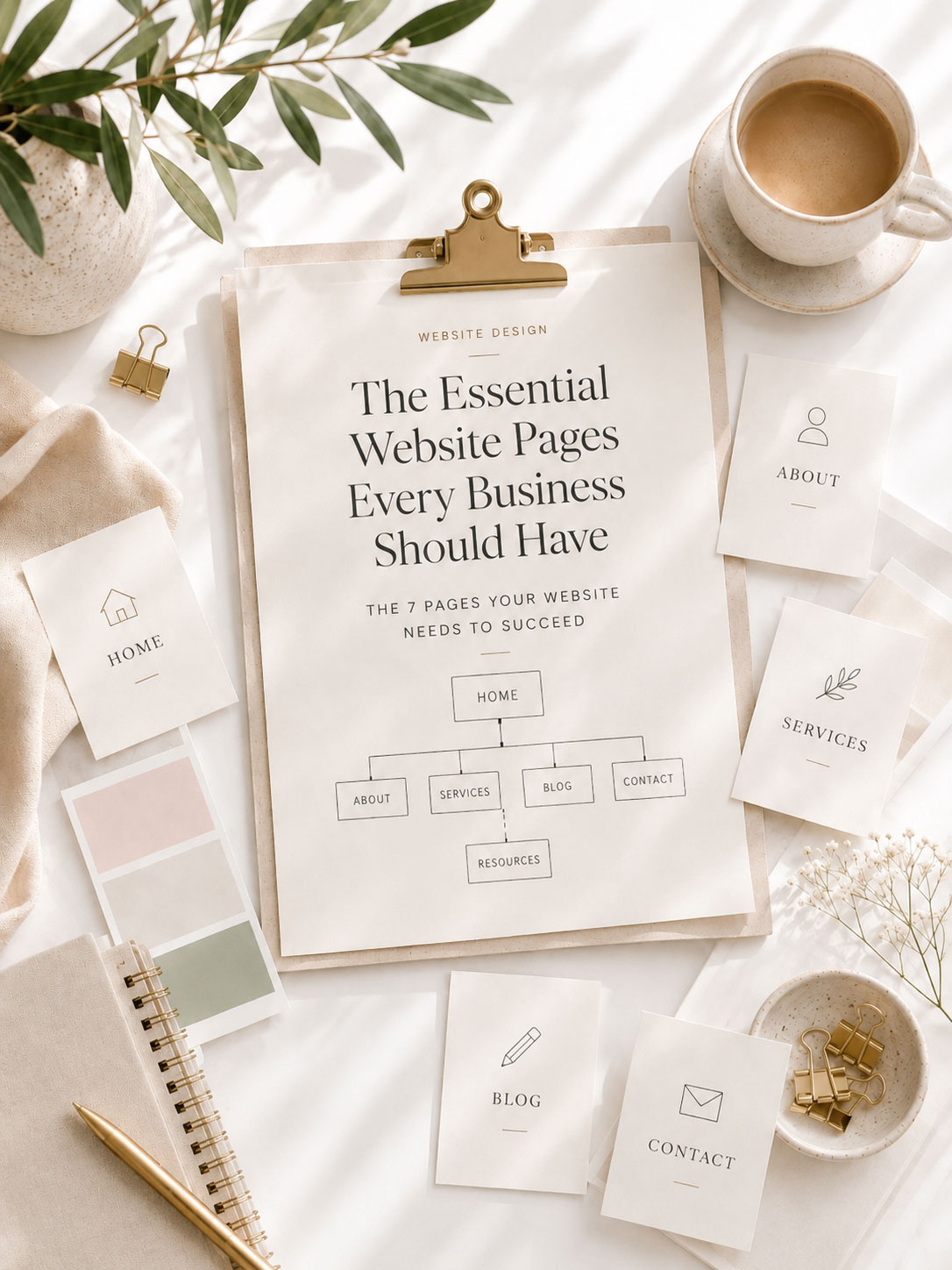
Turn These Ideas Into Your Website
Now that you know which pages your website needs, explore WordPress themes designed to help you build them with confidence.
Some Common Design Questions
Still have questions? Here are a few quick answers to some of the most common questions about this topic.